
Practical guide
Plan fleet graphics around vehicle availability
Start with the vehicles the business must keep in service before proposing installation batches.
Read the guide: Plan fleet graphics around vehicle availabilityChicago commercial vehicles & fleets
Plan commercial graphics around the vehicles your operation still needs. Keep the rollout, coverage and approvals connected.
Guaranteed response within 2 hours.Free planning tools and buyer downloads below.
A clear scope before the spend.
Free fleet rollout scheduler below. Use the result with any wrap shop.
More useful project detail
Build a working scenario around operational vehicle demand, then distinguish that scenario from actual confirmed shop arrangements.

A visual you can keep
Start with operational demand, then confirm the actual arrangements.
Use the planning example from Chicago Fleet Wraps, download a copy, or read the related project guides.
Practical guide
Start with the vehicles the business must keep in service before proposing installation batches.
Read the guide: Plan fleet graphics around vehicle availabilityPractical guide
Keep artwork, vehicle information and physical readiness connected to the batch that is supposed to enter the shop.
Read the guide: Use readiness checks before releasing each fleet batchPractical guide
Record the affected units, confirmed impact and revised sequence when availability or scope changes.
Read the guide: Handle a fleet rollout change without losing the planPicture the possibilities
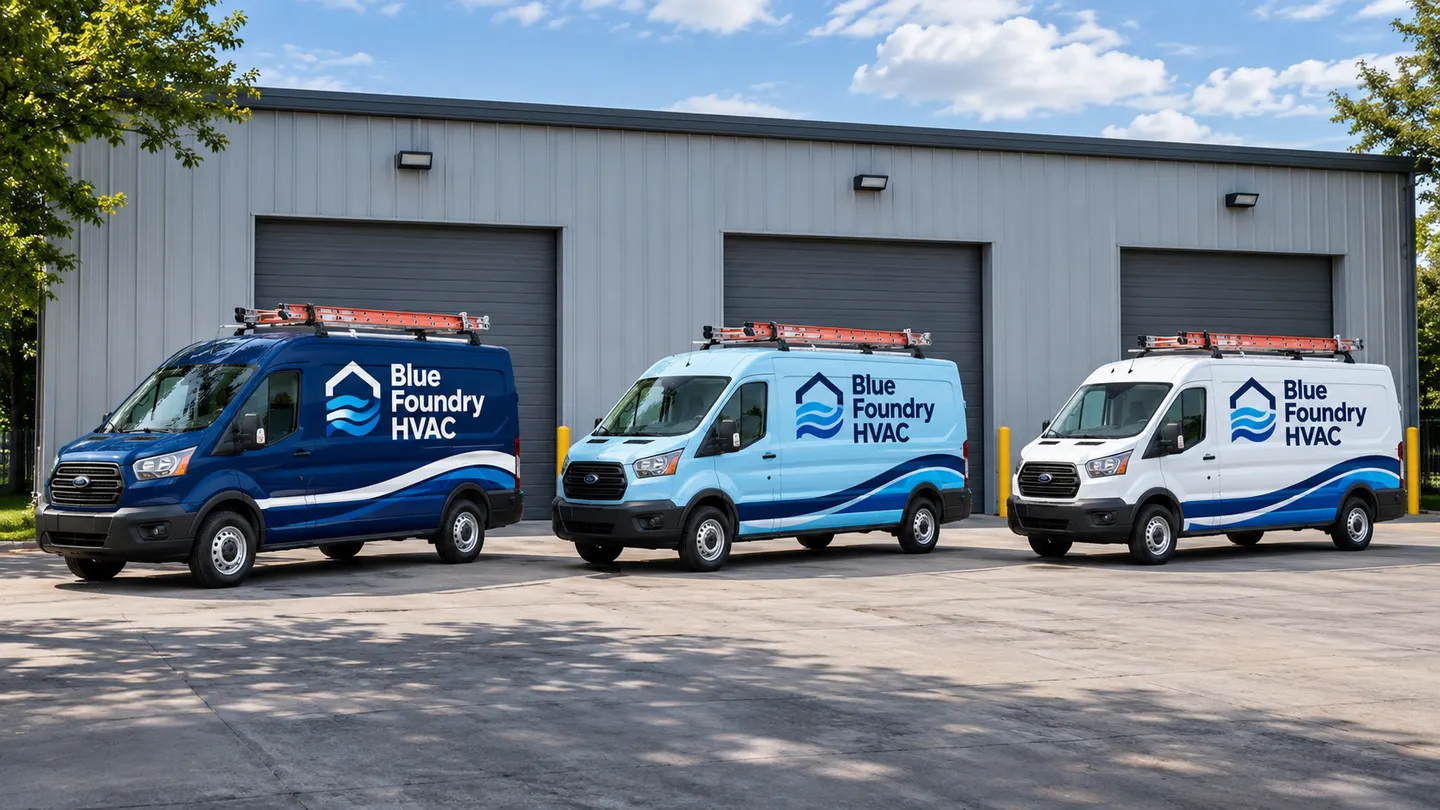
Look at the message, the coverage and the working views.
Blue Foundry HVAC is a fictional business. These generated design concepts illustrate ideas to discuss for your vehicles.
Plan the graphics for your vehiclesWhy put your business on a vehicle?
Keep the important colors, wording and identity consistent across the vehicles.
Keep vehicle and artwork records so the next unit starts from an agreed reference.
Plan batches, approvals and vehicle availability before agreeing the rollout.
A clear scope before a price
Vehicle size, covered areas, artwork, preparation, existing graphics and the proposed material system all belong in the price discussion.
Useful when the priority is a clear name, service and contact route.
Discuss this scopeCompare the exact panels, message and finish with the full-coverage option.
Discuss this scopeConfirm the included painted panels and any exclusions on the actual vehicle.
Discuss this scopeRequest a price for the actual vehicles and agreed coverage. The free tools below help you compare the assumptions.
Let’s talk vehicles
Tell us how many vehicles you have. We’ll follow up about the vehicles, coverage, design and timing.
Guaranteed response within 2 hours.Know the next step
Guaranteed response within 2 hours. Final project pricing and dates follow review of the scope.
Name, email, phone and vehicle count. Share the project context through the free tool if it is useful.
Discuss the actual vehicles, coverage, artwork, existing graphics and timing.
Check the written scope and vehicle-specific artwork, including the business wording and included surfaces.
Confirm scheduling, preparation, review and the applicable care information.
The free tool
Use the example values to explore, then replace them with your project details.
Use the tool without sharing contact details. Entering a valid email or phone in the inquiry form saves your project entries, filenames, analysis and selected original files, even if unfinished. Original files: up to 50 MB each and 200 MB per batch.
Sequential batches keep the stated minimum in service under your assumptions.
| Batch | Vehicles | Working start | Working finish | Available to work |
|---|---|---|---|---|
| 1 | 2 | 2026-12-01 | 2026-12-01 | 10 |
| 2 | 2 | 2026-12-02 | 2026-12-02 | 10 |
| 3 | 2 | 2026-12-03 | 2026-12-03 | 10 |
| 4 | 2 | 2026-12-04 | 2026-12-04 | 10 |
| 5 | 2 | 2026-12-07 | 2026-12-07 | 10 |
| 6 | 2 | 2026-12-08 | 2026-12-08 | 10 |
This is your planning scenario. Shop capacity, preparation, transport and actual installation dates must be confirmed.
Ready to discuss the vehicles? Get fleet pricing. Save your result to use in that conversation.
Free tools for a better buying decision
A 12-page workbook with generic wrap concepts and fillable worksheets for coverage, quote comparison, budget, fleet availability, artwork, proof approval and vehicle records. Use it with any wrap shop.
Fill it in electronically or print it. No email needed.
Take this to any wrap shop
Print it off so you remember to ask. A practical checklist covering scope, materials, artwork, preparation, scheduling, warranty and handoff, plus questions for this project.
Confidence comes from the details
Use these checks when you review a proposal, a proof or a wrap shop. Keep the answers with your project.
Print the wrap-shop questionsSee the tradeoff
With 12 vehicles, 10 needed in service and two assumed slots, six two-vehicle batches take six working days at one day per batch.
Illustrative values, not a completed customer project.
Sequential batches keep the stated minimum in service under your assumptions.
| Batch | Vehicles | Working start | Working finish | Available to work |
|---|---|---|---|---|
| 1 | 2 | 2026-12-01 | 2026-12-01 | 10 |
| 2 | 2 | 2026-12-02 | 2026-12-02 | 10 |
| 3 | 2 | 2026-12-03 | 2026-12-03 | 10 |
| 4 | 2 | 2026-12-04 | 2026-12-04 | 10 |
| 5 | 2 | 2026-12-07 | 2026-12-07 | 10 |
| 6 | 2 | 2026-12-08 | 2026-12-08 | 10 |
This is your planning scenario. Shop capacity, preparation, transport and actual installation dates must be confirmed.
Leave with something useful
Plan installation batches around the vehicles you need on the road. See the schedule before you ask about dates.
Build my fleet rolloutBuild it from the project details you enter.
Keep the assumptions and open questions visible.
Copy, save or print the result for your next conversation.
Commercial wrap service
To prepare a phased fleet graphics rollout, group vehicles by operational availability, identify the artwork approval contact, and list constraints for each group. Discuss the proposed sequence before assigning firm dates. Confirm preparation, handoff, and return arrangements directly so the business can plan around agreed information.
Replacing or introducing fleet graphics affects more than the marketing calendar. Dispatchers, drivers, branch managers, and customer teams may all depend on the vehicles continuing their normal work. A phased discussion can begin by identifying sensible groups and the periods when each could be available. This page helps a Chicago business prepare that information for a commercial graphics inquiry. It does not prescribe installation durations or reserve dates; those arrangements need to be discussed for the proposed scope.
Start with how the business uses its vehicles rather than a simple alphabetical list. Some may cover the same routes, carry specialized equipment, or support customers who need continuous service. Identify combinations that could be made available without assuming the business can release them all together. Keep the grouping provisional until scheduling is discussed. Include differences in body configuration or existing graphics that may need separate attention. The purpose is to make the operational constraints understandable, not to promise that each group can be completed in a particular window.
A fleet rollout often repeats the same business identity across several vehicles. Identify the contact who can approve the shared message, logo use, and contact details before local teams begin making separate requests. Record legitimate variations such as unit identifiers or different body styles. Explain whether the first proposed group is intended to establish a reference for later work. This makes the approval discussion more deliberate and helps the business avoid sending inconsistent instructions as new vehicles enter the project conversation.
An agreed sequence needs practical information about access, drivers, equipment, and vehicle availability. Identify who can bring each vehicle, answer condition questions, and coordinate its return to service. Ask what preparation and post-installation guidance should be incorporated into the operating plan. Do not build an internal calendar around an assumed installation duration or a target date that has not been confirmed. Keep a record of arrangements for each group so a change affecting one vehicle does not create confusion across the rest of the fleet.
Buy with the questions answered
Yes. Shared colors, typography and messages can connect a fleet while placement is adapted to each body. Group the vehicles by configuration and review each layout before repeating it.
Guaranteed response within 2 hours. The next conversation confirms the vehicle details, proposed coverage, artwork, existing graphics and timing so a project-specific scope can be discussed. Sending an inquiry does not reserve an installation date.
Review the covered surfaces, final business wording, vehicle-specific artwork, proposed material system, preparation and removal needs, price exclusions and agreed handoff. The free wrap-shop questions give you a record to use with any supplier.
Before you decide
For project-specific help, use the four-field inquiry form.
Get fleet pricingA phased scope can be discussed by clearly identifying the proposed vehicle groups and their operating constraints. Explain why the grouping matters to the business. The sequence, scheduling, and suitability of those phases need confirmation rather than an assumption that every proposed batch can use the same arrangements.
Read the detailed guide: Plan fleet graphics around vehicle availability
Start with the number your business could realistically make available together, then discuss that proposal with the project contact. Include vehicle differences and customer commitments. There is no single batch size established by this page, because the actual scope and scheduling arrangements need to be considered.
Read the detailed guide: Plan fleet graphics around vehicle availability
Drivers or fleet coordinators can help identify equipment, access issues, and commitments that a central marketing contact may not know. Collect that information through a clear internal process. Keep artwork approval and operational coordination responsibilities distinct so each question reaches someone who can answer it.
Read the detailed guide: Use readiness checks before releasing each fleet batch
Base business communications on confirmed arrangements rather than an initial target date. First discuss the vehicle scope, availability, and preparation questions. Once the relevant details are agreed, your operations team can decide what customers or dispatchers need to know and how changes will be communicated internally.
Read the detailed guide: Plan fleet graphics around vehicle availability
Preparation, coverage, vehicle shape, existing graphics and the installation team affect downtime. Obtain a project-specific schedule before committing vehicles to a fleet rollout.
3M sourceContamination and trapped moisture can undermine adhesion. Seams, crevices and areas beneath seals need attention as part of the final cleaning and drying process.
ORAFOL sourceAn installation plan should include the specified bonding period before release. 3M's trailer guidance recommends at least 24 hours for the graphics to bond before the trailer returns to service.
3M sourceUse the finished graphic's care instructions, start with a mild cleaning method, test an inconspicuous area and avoid unnecessary abrasion. Cleaning compatibility depends on the finished graphic.
3M sourceChicago fleet operators can use this planning structure to discuss vehicle availability and confirm local project arrangements. Tell us about your vehicles.